Neuro & ImmuneRA10
Single or box

Loading product
Neuro & Immune · Research material
Package information
For product inquiries and additional information, contact lonestarpeptideco@gmail.com.
Compliance notice: For laboratory research use only. Not for human or veterinary use.
Product information is intended for laboratory, academic and commercial researchers aged 18 or over.
Material profile
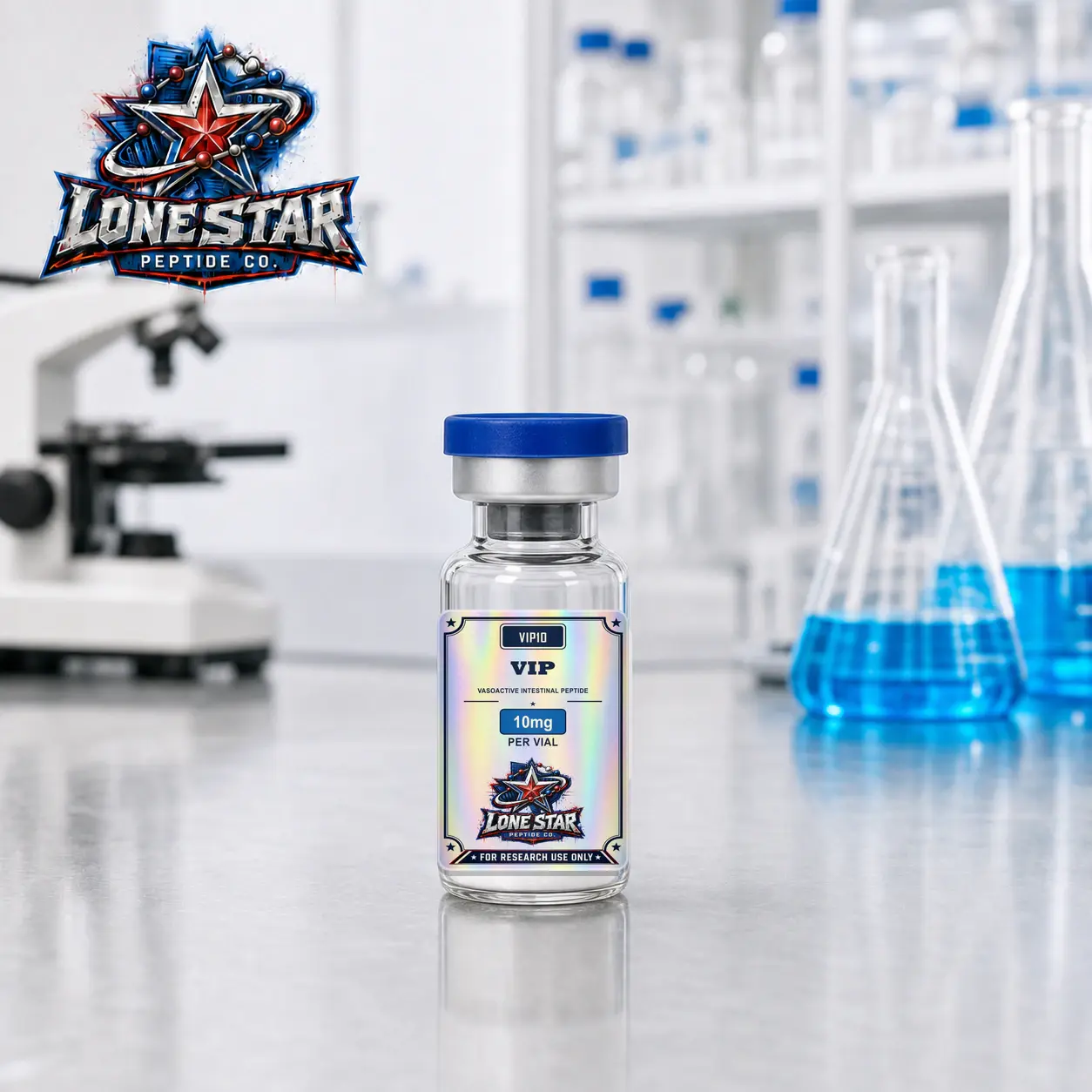
A 28-residue C-terminally amidated member of the secretin/glucagon peptide superfamily, first characterised from porcine intestinal extracts. This listing is one vial with a 10 mg fill. A box of 10 is available as an optional package. It is catalogued as a research-grade reference peptide for receptor-binding, electrophysiology and analytical method work. For laboratory research use only. Not for human or veterinary use.
Catalog record
| Product | VIP (Vasoactive Intestinal Peptide) — 10 mg |
|---|---|
| Catalog SKU | VIP10 |
| Compound | VIP (Vasoactive Intestinal Peptide) |
| Appearance | Lyophilized white powder |
| Fill per vial | 10 mg |
| Storage condition | -20 °C, desiccated, protect from light |
Laboratory handling
Arrives as a sealed lyophilized vial inside an insulated cold-shipped carton. Store at -20 degrees C, desiccated and protected from light; short-chain peptides of this type degrade fastest under combined humidity and UV exposure. Open, aliquot and dispose of the material strictly according to the receiving laboratory's own protocols.
Evidence first
This listing does not currently publish lot-specific analytical results. Request and review the applicable documentation before using the material in laboratory work.
Published literature
VIP is a 28-amino acid peptide of the secretin/glucagon structural superfamily, characterized by a central alpha-helical region, a disordered N-terminal His1-Phe6 segment, and a short 3(10) helix near the C-terminus. Structural and mutagenesis studies examined VIP's interaction with the VPAC1 receptor, a class II (B) G-protein-coupled receptor, identifying specific VIP residues (Phe6, Tyr22, Asn24) that contact residues in the receptor's N-terminal ectodomain. VPAC1 and VPAC2 receptor signaling was examined via cAMP-dependent pathways, along with calcium mobilization and protein kinase C activation in some cell systems, and separate research examined VIP-VPAC receptor systems as autocrine/paracrine regulators of T-cell function.
Describes what the cited studies examined in the systems noted above — not a claim about outcomes for people. Not medical advice.
Product support
No downloadable certificate is currently attached to this listing. Email lonestarpeptideco@gmail.com if your laboratory requires lot-specific documentation for review.
Use the package selector to review the single-vial and box-of-10 formats, then use Email to inquire if you want to ask about that product.
The catalog storage condition is -20 °C, desiccated, protect from light. Follow the handling information on this page and your laboratory's written procedures.
No. It is presented only as laboratory research material and is not for human or veterinary use, food, drugs, cosmetics, household use, or self-administration.
Catalog navigation
Other catalog records grouped under the same editorial collection.
Product inquiries
Contact Lone Star Peptide Co. for product information and inquiries.
Email to inquireRequired notice
For laboratory research use only. Not for human or veterinary use, food, drugs, cosmetics, household use, or self-administration. Product information is provided for material identification, handling, and analytical documentation; it is not medical advice or a statement of clinical safety or effectiveness.